On this page
A website quote can look reassuringly precise. It names the pages, sets a delivery date and gives a total. Yet a buyer may still be unable to explain what the business will receive. The missing detail is not always another feature. It may be a decision that neither side has made.
That distinction matters when comparing proposals. A lower price may reflect a sensible, smaller job. A higher one may include work the business does not need. Neither total reveals much if the suppliers have priced different assumptions about the same request.
Agree what each deliverable means
The useful question is therefore not simply whether something is included. It is whether the business and supplier agree what that thing means. “Online enquiries” could describe a basic message form or a process that collects photographs, routes requests and sends different replies. A familiar label can conceal an unfamiliar amount of work.
An illustrative cleaning-business example
Consider a hypothetical cleaning business commissioning its first website. This is an illustrative example, not a customer case study. The owner wants customers to “book online”. One proposal includes a form asking for contact details and a preferred date. Another includes a calendar with selectable appointment slots. Both appear to answer the brief.
But the owner needs to inspect some properties before agreeing to the work. Selecting a time cannot always mean that a cleaning appointment is confirmed. Until that business rule is settled, comparing the two totals is comparing different promises to the customer.
For the initial launch, the owner could decide that customers will request an assessment. The website will explain that the request needs confirmation, and a named member of staff will respond. Instant booking could be considered later for services with a defined scope. That decision may change what is being bought without saying anything about either supplier's competence.
Separate included, deferred and unresolved work
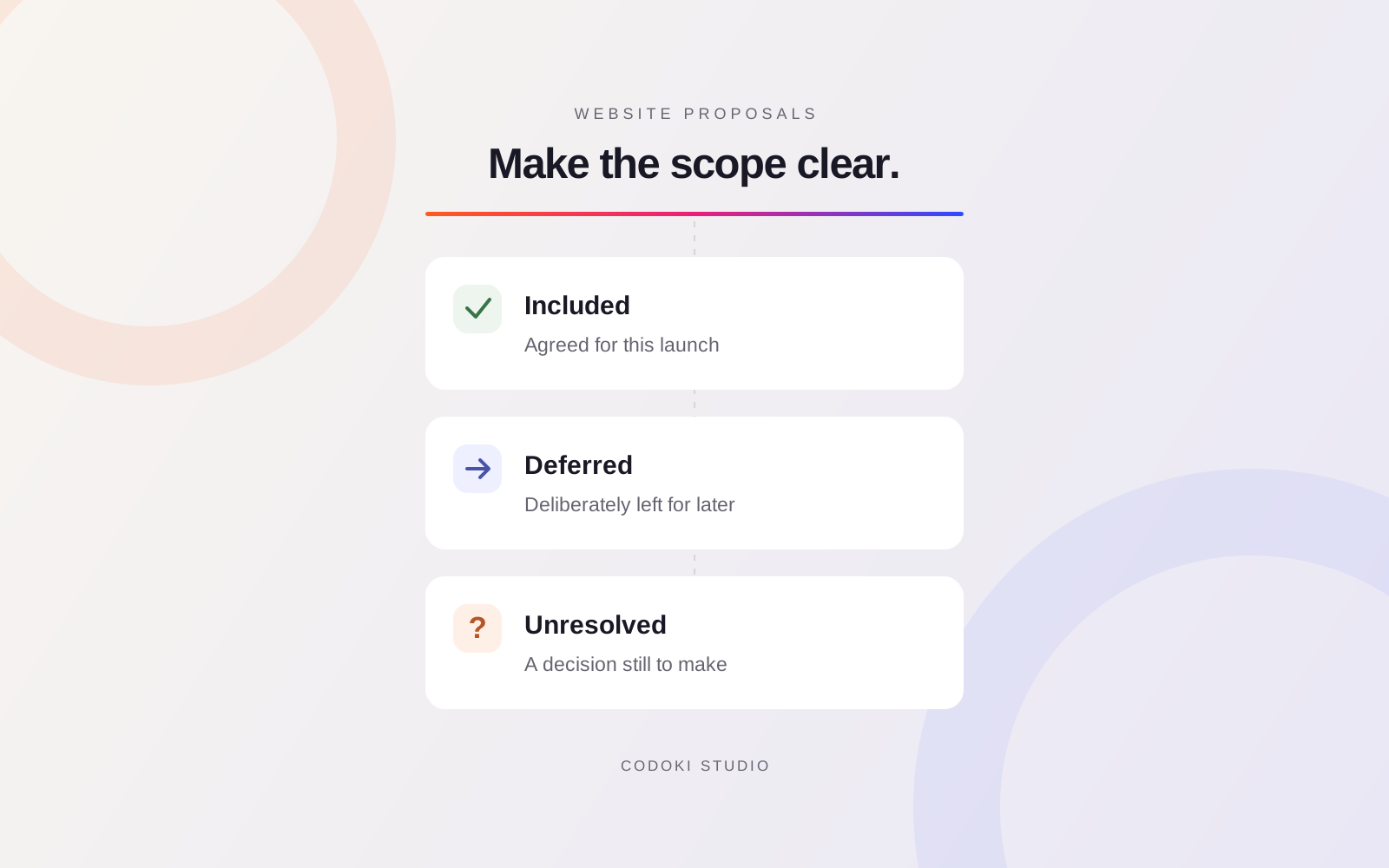
Three labels can make the distinction visible: included, deferred and unresolved. Included means the current proposal describes an agreed deliverable and its limits. Deferred means both sides have deliberately left an item out of this launch. Unresolved means a decision is still required before its effect on the work can be understood.
Deferred should never imply “already paid for and available whenever wanted”. It needs a clear note about whether a later phase would require a new estimate. Equally, an explicitly excluded feature should stay outside the scope unless the parties agree a change. Unresolved is the category that prevents an unanswered question from quietly becoming an assumed inclusion.
For the cleaning business, the request form might be included, instant confirmation deferred and the need for photo uploads unresolved. The owner should identify who will settle that last question and by when. If it affects the proposed work, the supplier should explain any consequences before the scope is agreed. A blank space is not an estimate.
Make responsibilities and acceptance clear
The buyer's own responsibilities deserve the same treatment. “Content supplied by the client” leaves room for questions about who writes service descriptions, chooses photographs and approves the finished pages. If the owner expects writing help while the supplier expects finished copy, neither a page count nor a launch date resolves the mismatch.
An agreed example can also make an inclusion easier to assess. For an enquiry form, describe what the customer enters, who receives it and what confirmation appears. Include the failure case: if the message cannot be sent, the page should not tell the customer it was delivered. This turns an abstract feature into a shared description of finished work.
Compare the same agreed job
The aim is not to produce a vast technical specification before speaking to a developer. It is to make uncertainty visible enough to discuss. A supplier can then explain a trade-off, propose a simpler approach or identify a decision that needs more work.
Once the proposals describe the same agreed job, price becomes a more useful comparison. A small business can choose a modest launch with confidence about its boundaries. The most valuable clarification may be one sentence that stops two people buying and selling different versions of the website.