On this page
- Separate four parts of the budget
- Describe a workload before requesting a monthly estimate
- Use an assumptions record with the estimate
- Check the units behind provider prices
- Ask what actually happens at the spending boundary
- Replace assumptions with observed pilot evidence
- Compare extra cash spending with review time released
An AI build price can leave the operating budget uncertain. Ask about hosting, model requests, connected services and human review alongside the delivery scope. Compare proposals for the same job over the same period.
This budgeting exercise uses a fictional business and workload. It is not a market price list, Codoki Studio quotation, provider charge or promised saving.
Separate four parts of the budget
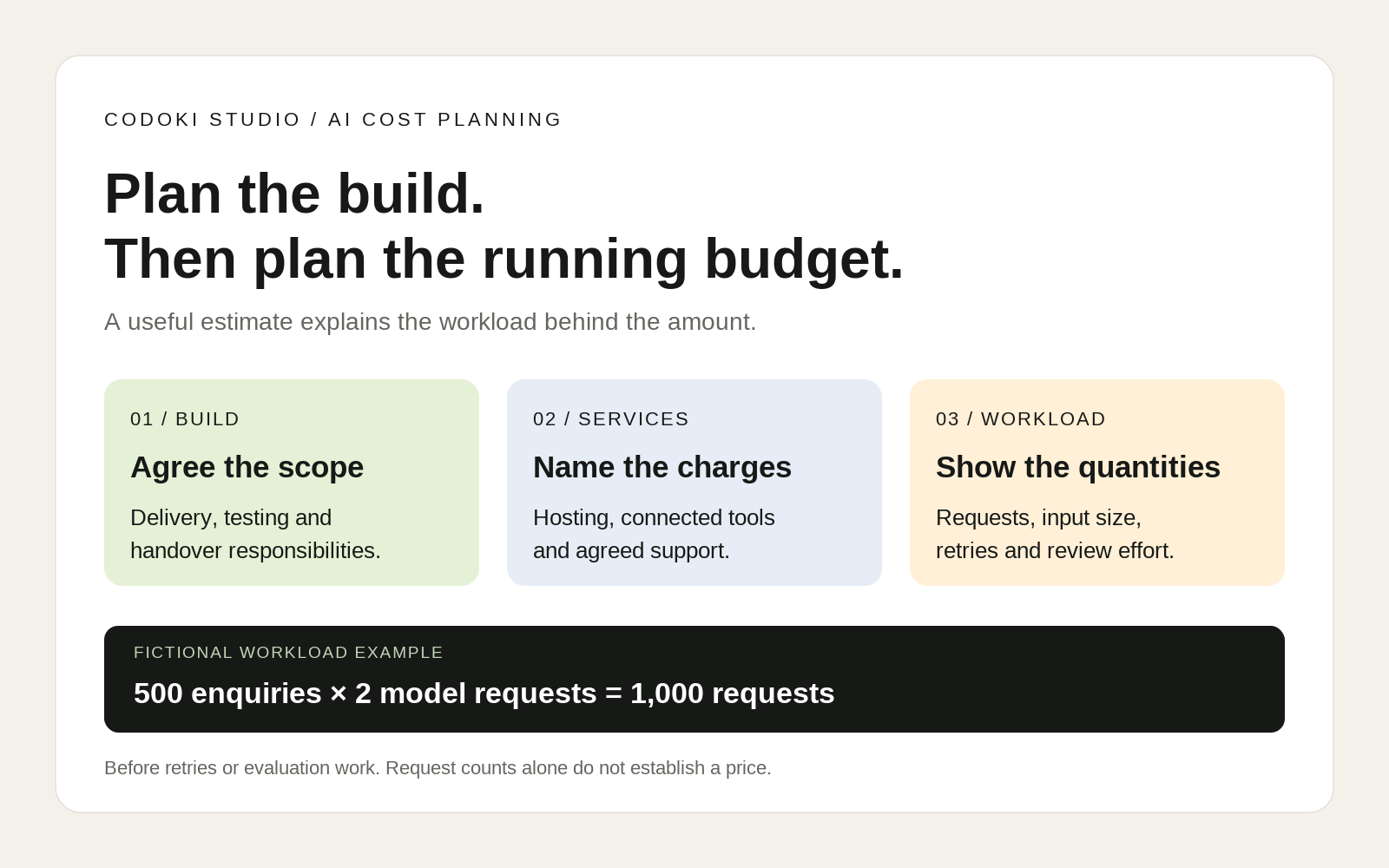
Start with the work needed to deliver the first usable version. Discovery, interface design, integrations, access controls, testing and handover belong in the build scope. Ask which are included, which depend on unresolved decisions and which would require a separate change. A prototype and an operational service may have different deliverables.
Then distinguish recurring service charges from usage. Hosting or an agreed support arrangement might have a fixed period and allowance. Model processing, document handling or connected tools may vary with activity. Some products combine a subscription with an allowance and extra charges above it; ask where each boundary falls.
Keep human work visible too: checking outputs, resolving exceptions and maintaining source information. Internal staff time may not appear on a supplier invoice, but it still affects whether the workflow is useful. Record it separately from cash charges rather than quietly treating it as free.
Describe a workload before requesting a monthly estimate
Imagine Bracken Training, an invented business preparing course-enquiry summaries for a coordinator. Its pilot reads an enquiry, creates a draft summary and leaves a review item. It cannot send replies or confirm places. The business wants to understand operating costs before extending the pilot.
For discussion, the owner supplies three fictional monthly workloads: 200, 500 and 1,000 enquiries. These are planning scenarios, not forecasts. The supplier also needs to know how long the enquiries are, whether attachments are included and how much reference material is sent with each request. A count of enquiries alone cannot answer those questions.
An enquiry is also not necessarily one model request. A workflow may classify it, retrieve information, draft a summary and try again after an unsuccessful result. Ask the supplier to trace one ordinary enquiry and one awkward example, then identify each chargeable step and the rule that limits repeated attempts.
Suppose the fictional design makes one classification request and one summary request for every enquiry. Its starting calculation is 500 enquiries × 2 requests = 1,000 model requests before retries or evaluation work. The 200- and 1,000-enquiry scenarios become 400 and 2,000 requests respectively. These are arithmetic assumptions to test, not measured usage. The supplier still needs input and output quantities for each step, applicable rates and any separate tool charges to turn them into a money estimate.
Use an assumptions record with the estimate
For Bracken Training, a useful first record would contain the following entries. Leave unmeasured quantities marked unknown. Fill them from an agreed test and the relevant supplier terms before relying on a total.
- Build: one summary-and-review workflow, one agreed mailbox connection and a review screen. Supplier lists deliverables, exclusions and acceptance evidence; business owner approves scope.
- Hosting and storage: describe the environment, retention period and expected stored material. Supplier identifies fixed charges, included allowances and usage-based elements.
- Model usage: record requests per enquiry, input size and output size for ordinary and awkward examples. Supplier supplies the chosen provider, model, billing units and dated rates.
- Connected tools: list document processing, search, email or workflow services actually used. Record each allowance and what happens when it is exceeded.
- Human review: record review and correction time per accepted summary, plus exception work. The business supplies observed times from the pilot rather than assuming every draft is usable.
- Changes and support: name the owner for failures, source updates and model changes. The proposal states what ongoing support includes and what needs a separate estimate.
Add who receives each invoice and who can inspect usage. State the currency, tax treatment, billing period and expiry date of the estimate. Where a charge is unknown, show what must be measured or confirmed and who will do it. A blank amount should never silently become zero.
Check the units behind provider prices
For text models, a token is a unit used to process text; it is not the same thing as a customer enquiry. Anthropic’s pricing documentation separates input and output usage and describes additional charges for some tools. The point for a buyer is to ask which categories the estimate includes, rather than multiplying enquiries by a single advertised token price.
Other parts of the system can have different units. Amazon Bedrock’s pricing page separates model processing from capabilities such as document processing and knowledge retrieval. These are examples of billing structures, not required products or recommendations to buy them. Use the current terms for the actual proposed stack.
A simple forecast can be expressed as fixed operating charges, plus estimated usage for each service, plus agreed support. Show initial setup separately. Report internal review effort alongside that cash forecast. Avoid combining different units or adding the same included allowance twice.
Ask what actually happens at the spending boundary
Agree what the system should do when workload exceeds the plan: queue work, restrict input size, pause a feature or ask a named person to approve expansion. Make the customer-facing message and manual fallback clear. Decide who checks exceptions and how unfinished items are recovered after a pause.
An alert is not automatically a spending cap. AWS Budgets documentation, for example, explains that notification can arrive after charges are incurred. Ask the supplier to demonstrate any promised limit in a safe test and explain its delay, scope and failure behaviour. Keep provider billing alerts distinct from application controls.
Replace assumptions with observed pilot evidence
Run representative synthetic examples through an isolated test setup. Record the configuration, processing attempts, billable units and whether the intended result was accepted. Measure review and correction effort as well. Include a long input, an unusable output and an interrupted dependency rather than evaluating only the easiest demonstration.
Pilot comparison record
Configuration / date:
Workload and input-size range:
Measure                  Forecast     Observed
Enquiries processed      ___          ___
Model requests           ___          ___
Input / output units     ___ / ___    ___ / ___
Separate tool usage      ___          ___
Accepted summaries       ___          ___
Review / correction time ___          ___
Cash charges / currency  Unknown      Unknown
Difference and explanation:
Next decision / owner:
Compare the forecast with the observed pilot quantities. A lower cost per model request may not produce a lower cost per accepted task if it needs more retries or correction. Explain any difference before increasing volume. A small pilot informs the next decision; it does not establish a guaranteed saving at full scale.
Compare extra cash spending with review time released
Return to fictional Bracken Training. Suppose two proposed configurations can both produce 500 accepted summaries a month after human review and correction. For this exercise, they meet the same acceptance criteria, handle the same input mix and include the same support scope. Those are assumptions to verify in a pilot, not evidence that either configuration works.
- Configuration A: £120 fixed monthly charges + (500 enquiries × £0.08) = £160 monthly cash spending. At an assumed two minutes of review and correction per enquiry, staff effort is 1,000 minutes: 16 hours 40 minutes.
- Configuration B: £180 fixed monthly charges + (500 enquiries × £0.18) = £270 monthly cash spending. At an assumed 45 seconds per enquiry, staff effort is 375 minutes: 6 hours 15 minutes.
- Decision at 500 enquiries: B requires £110 more cash each month and releases an assumed 625 minutes, or 10 hours 25 minutes, of staff capacity.
The owner now has a concrete trade-off. Can the team use those hours for work that justifies the extra £110? Existing salaries do not fall automatically when a task takes less time. Report the capacity released separately; call it a cash saving only if a specific payment, such as approved overtime, actually falls. Any extra setup cost for B also belongs in the purchasing decision.
Check a quieter month before deciding. At 200 enquiries, the same assumptions give A £136 and B £216: £80 more cash for B. Review effort becomes 6 hours 40 minutes versus 2 hours 30 minutes, releasing 4 hours 10 minutes. A choice that looks worthwhile at 500 enquiries may be harder to justify at 200; neither workload is a forecast.
Replace both time assumptions with observed review, correction and exception-handling time. Count unresolved or unusable summaries separately. If one option accepts fewer tasks or lowers quality, this equal-output comparison no longer holds: investigate the difference before choosing on price. Record the extra cash, usable capacity, quality evidence and next decision together.
Revisit the assumptions when the model, source documents, workflow or expected workload changes. Keep the dated estimate and the observed evidence together so somebody can see why the budget changed. Discuss an AI product or automation with Codoki Studio using one concrete workflow, its expected volume and the decisions that must remain with your team.