On this page
- The quick distinction: workflow, product or discovery?
- Choose AI automation when the problem is a repeated workflow
- Choose AI product development when someone needs a usable feature
- Choose SEO and GEO/AEO when the problem is discovery
- If the project needs all three, separate the decisions
- Copy this short brief before requesting proposals
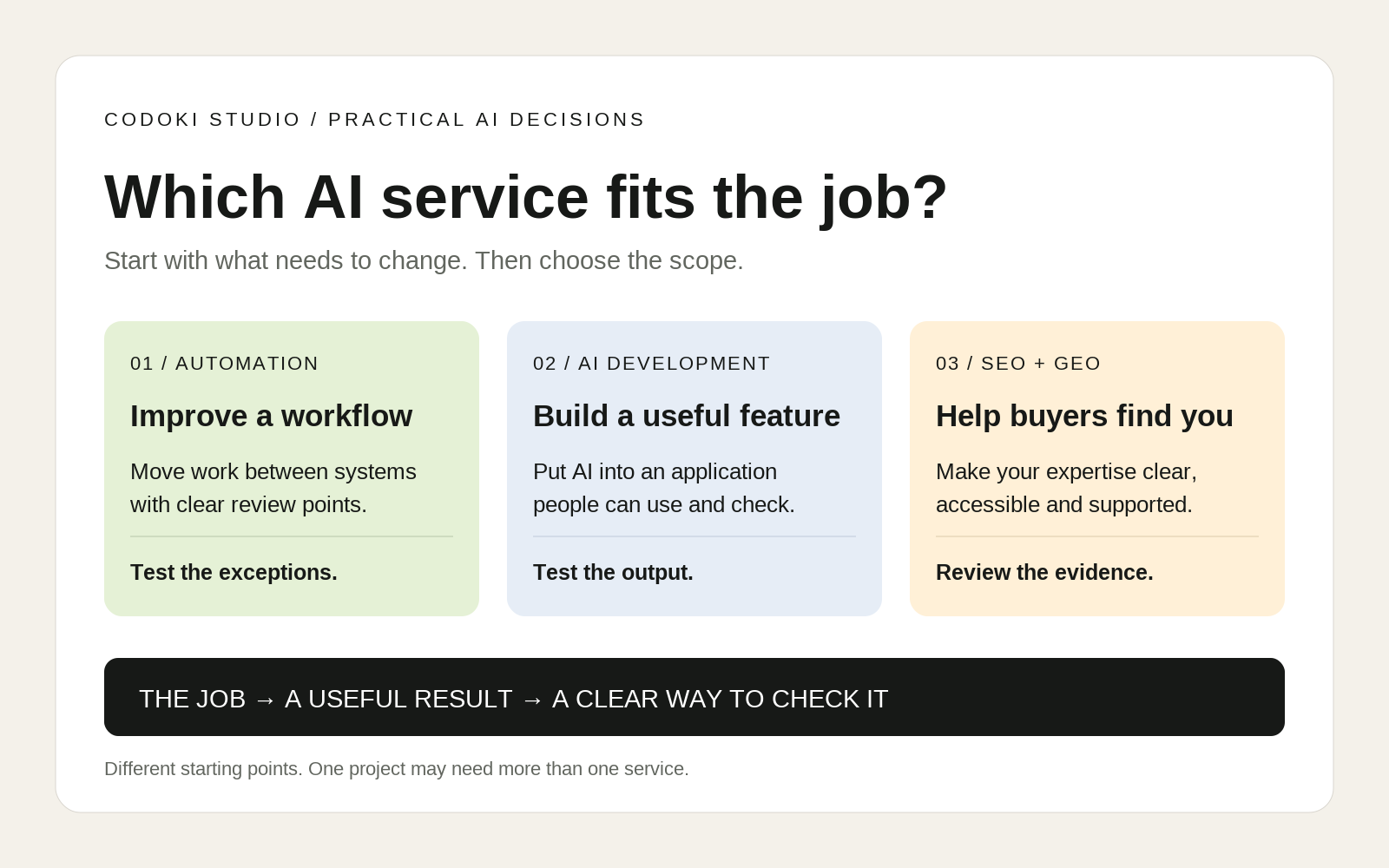
A request for “help with AI” can describe three very different jobs: moving work between systems, building a feature people use, or improving how buyers discover a business. Choosing the service by its name alone makes proposals difficult to compare. Start with what needs to change and the evidence that would show the change is useful.
This guide expands our social post on choosing an AI service into a practical buying framework. The examples below are fictional planning scenarios, not client case studies, fixed packages or promises of results.
The quick distinction: workflow, product or discovery?
- AI automation and implementation: improve how a task moves through the business, including its inputs, decisions, handovers and exceptions.
- AI product development: build an AI-powered feature into an application that a customer or team member can use.
- SEO and AI search optimisation: make the business and its expertise easier to discover and understand through search and generated answers.
These categories overlap. An AI-powered application may include automated workflows, and its website may need SEO. The distinction helps you agree separate deliverables and tests instead of buying one vague “AI solution”.
Choose AI automation when the problem is a repeated workflow
Imagine a maintenance company receiving enquiries by email. Staff read each message, identify the service requested and prepare a summary for a coordinator. A scoped automation could draft that summary and suggest a queue. The coordinator checks it before anything reaches a customer or changes a job record.
The first deliverable should describe the workflow: what starts it, which information it can read, what it produces and who handles an exception. An integration that moves a known field between systems may need fixed rules rather than AI. Ask the supplier to explain where interpreting free-form information adds value.
- Useful deliverables: a workflow map, agreed system connections, a review queue, exception handling and operating instructions.
- Acceptance questions: what happens with an incomplete enquiry, an unavailable destination or the same message received twice? Can staff see what happened and recover unfinished work?
- Ownership questions: who maintains the connections, checks failures and pays any ongoing provider charges? Which actions require a person’s approval?
A successful demonstration should follow a task through to its agreed destination. A polished summary alone does not show that the handover, permissions or failure handling work. Compare the effort of reviewing and correcting the output with the current manual process.
Choose AI product development when someone needs a usable feature
Imagine a training provider that wants a document-summary feature inside its customer portal. A customer uploads an authorised document, chooses a summary length and reviews the result beside the source. That requires a usable application journey as well as the AI request.
The brief should identify the users, supported inputs and decisions the feature helps them make. It should also explain what the feature does when it cannot produce a useful answer. A prototype can test the interaction before the team commits to a wider application build.
- Useful deliverables: a defined user journey, working application screens, access boundaries, source handling and a set of representative review examples.
- Acceptance questions: does the summary preserve important qualifications? Can the reader check its source? What happens when a document is unreadable, too long or outside the agreed scope?
- Ownership questions: who controls the application and provider accounts, updates the feature and decides whether a model change needs another evaluation?
Agree how outputs will be judged before assessing the demonstration. Include awkward examples as well as straightforward ones. A single impressive result is useful for discussion, but it cannot establish that the feature performs consistently across the intended work.
Choose SEO and GEO/AEO when the problem is discovery
Imagine a specialist supplier whose website lists products but barely explains installation, compatibility or support. Buyers need those answers when comparing suppliers. The relevant project is likely to involve useful service information, technical search checks and clearer evidence about the business.
GEO means Generative Engine Optimisation. AEO means Answer Engine Optimisation. The labels are used around visibility in generated answers and answer-focused search. They describe discovery work; they do not mean that your business needs its own chatbot or AI application.
Google’s guidance says established SEO practices remain relevant to AI Overviews and AI Mode. There are no additional technical requirements or special schema needed for those features, and meeting the requirements does not guarantee inclusion. The source is linked below; this Google guidance should not be treated as a promise about every AI platform.
- Useful deliverables: prioritised technical findings, buyer questions mapped to suitable pages, accurate content improvements and a record of what was published.
- Acceptance questions: can search engines access the intended pages? Do the answers match the real service? Are supporting facts and internal links clear?
- Measurement questions: which complete search-report periods will be compared? Which observations are measured, and which remain unknown? Treat a sampled AI mention separately from a qualified enquiry.
If the project needs all three, separate the decisions
A new AI application may need a workflow integration and a website that explains it. Keep one shared business goal, but review the work in stages. First establish who needs the feature and what it must do. Then test the workflow and application boundaries. Plan discovery content around the actual, agreed capabilities.
Ask for separate deliverables, dependencies and acceptance checks in the proposal. That makes it easier to start with the useful part, defer uncertain work and avoid promoting features that have not been established. A discovery discussion can also conclude that an existing tool or a simpler process is sufficient.
Copy this short brief before requesting proposals
- 1The problem: who is affected, what happens today and what needs to change?
- 2The first useful result: a completed workflow, a usable feature or better information for buyers?
- 3The boundaries: which people, records, systems and actions are included or excluded?
- 4The evidence: which examples will you review, and what would count as an acceptable result?
- 5The practical constraints: who decides, what budget range is available, and who will operate the work after launch?
Codoki Studio offers AI product development, automation and implementation, web development, SEO and AI search optimisation. Bring the problem and a few representative examples to an initial conversation. They give us a useful starting point for discussing the scope, alternatives and the next decision.