On this page
A web application quote is difficult to compare when it describes screens but leaves the behaviour behind them unstated. Two suppliers can both offer a customer login, a repair-status page and a staff dashboard while estimating different products. Before comparing their totals, make the data, permissions and operating responsibilities visible.
This guide uses a browser-based customer portal to show how scope changes the cost. It is separate from a marketing website, a native mobile app and an AI development estimate. The useful question is what each price actually buys, including the work needed after launch.
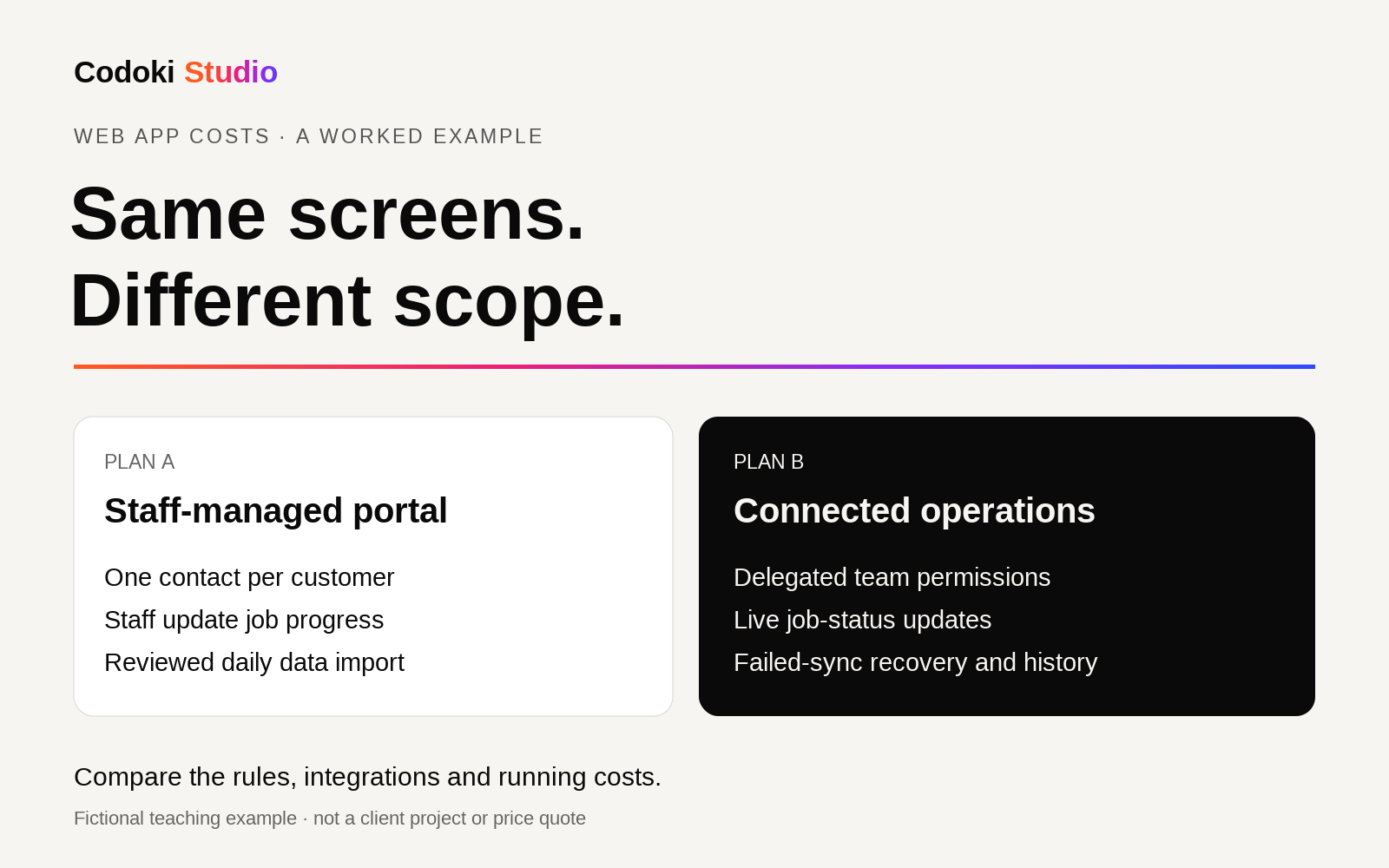
The same three screens, two different products
Imagine an equipment-servicing business whose customers repeatedly ask where their repair has reached. Version A gives each customer one named contact. Staff upload an agreed daily export from the existing job system, review rejected rows and publish the latest status. The portal shows when that information was last updated. Customers cannot change jobs or invite colleagues.
Version B keeps those same three main screens, but reads changes through the job system’s API. Each customer organisation can have several contacts with different access. Status changes trigger notifications; failed requests need retry handling, and staff need to see which changes have not synchronised. Those behaviours create additional design, implementation and review work even if the visual layout barely changes.
Neither version is automatically the right purchase. If a daily status update meets the actual need, live synchronisation may add complexity without enough benefit. If several customer departments need current information throughout the day, a daily export may leave the original problem unresolved. Agree that operational requirement before asking a supplier to price it.
Build a cost model with visible assumptions
For Version A, suppose the team records the following effort. “Build” includes configuring suitable existing components where appropriate; it does not mean writing every feature from scratch. The estimate assumes the job export is documented, sample records are available and the buyer can make timely decisions.
- Discovery and agreement of the workflow: 12 hours × £60 = £720.
- Interface design and review: 16 hours × £60 = £960.
- Customer login, status views and staff dashboard: 40 hours × £60 = £2,400.
- Daily import, validation and rejected-row reporting: 20 hours × £60 = £1,200.
- Permission checks, functional testing and agreed fixes: 24 hours × £60 = £1,440.
- Deployment, handover and staff training: 8 hours × £60 = £480.
That is 120 hours and £7,200 for the initial delivery. It assumes one agreed data format, a defined initial import and the stated contact model. Cleaning years of inconsistent customer records, redesigning the source job system or adding customer payments would change that scope. Put those exclusions beside the estimate so that a lower headline price cannot hide a different boundary.
Now suppose Version B retains the daily import for initial loading and as an agreed fallback, then adds the live features. Its extra work is 24 hours for the API connection (£1,440), 16 for organisation contacts and permissions (£960), 12 for notification and retry behaviour (£720), and 20 for integration-failure testing and operational handover (£1,200).
The additional 72 hours cost £4,320. Version B therefore totals 192 hours and £11,520. These are incremental hours for this fictional comparison, not a universal integration surcharge. A real supplier should explain what is retained, replaced or added; otherwise the same work can accidentally appear twice in a quote.
Separate delivery, running costs and money held in reserve
For this example, assume Version A needs £60 a month for hosting and related services plus a £180 monthly support allowance. Its twelve-month running-cost allowance is £2,880, giving £10,080 for delivery plus the first twelve months of operation. Assume Version B needs £100 and £240 respectively: £4,080 a year and £15,600 including delivery.
Those monthly figures are invented planning allowances too. They do not establish a service level or unlimited maintenance. Specify what the support allowance covers, who monitors failures, whether unused time expires, and how usage charges or additional work are authorised. Existing job-system licence charges and any API access fees also need checking; they are not included in this illustration.
If the buyer separately reserves 15% of the initial delivery estimate for uncertainty, that reserve is £1,080 for A or £1,728 for B. Total funds planned become £11,160 and £17,328 respectively. The reserve is held by the buyer, not automatically invoiced or spent. Record an approved change against it before treating it as a project cost. Staff time for reviewing data and accepting the work remains a separate internal commitment.
Agree what finished means and who does what
A cost comparison becomes more useful when each scope includes an observable delivery boundary. For A, an agreed sample import should update the intended records, report rejected rows and show the update time. A contact must see only the permitted customer’s jobs. For B, add demonstrations of access for multiple contacts, a failed synchronisation and recovery without unintended duplicate notifications.
OWASP’s authorisation guidance recommends checking permissions on every request. A hidden menu item alone is therefore not enough evidence that one customer cannot access another’s records. Keep the agreed permission behaviour and its verification in the delivery scope, rather than treating it as optional polish when reducing a price.
The buyer supplies representative non-sensitive sample data, confirms who may see each record and provides an authorised owner for the existing system. The supplier documents assumptions, implements the agreed behaviour and hands over operating instructions. Both parties agree acceptance decisions, unresolved issues and the process for changes. Hours are effort, not elapsed calendar time: access delays and review availability still affect the schedule.
Where AI coding and existing software fit
An AI coding tool may help produce or revise implementation code. It does not settle which customer should access a record, whether the external system permits an integration or who will respond when synchronisation fails. Ask a supplier using such tools to explain the delivered scope and review process; compare the accepted product and responsibilities, not an unsupported promise of a fixed speed saving.
Before commissioning either version, test whether the current job system already offers a suitable customer portal. A configurable product may cover the workflow with less custom work, although its licence, setup, permissions, export options and support still need examination. Custom development is easier to justify when an important requirement remains unmet after that comparison.
Bring prospective suppliers the same workflow, sample data, access rules and operating expectations. Request separate delivery and recurring costs with assumptions attached. That gives you a basis for choosing an appropriate scope and comparing offers without pretending that a page count alone defines a web application.